
Since the dawn of time, bacteria have evolved sophisticated ways to wage war against one another. Among the most fascinating of these natural weapons are colicins — protein toxins produced by certain strains of Escherichia coli (E. coli) to eliminate competing bacteria. This article examines how these remarkable molecules were discovered and why they are attracting renewed scientific interest today.
The infamous outbreak of 2006
In September 2006, an outbreak of food-borne illnesses caused by E. coli O157:H7 occurred. Spanning the United States and Canada, the outbreak was therefore dubbed the ‘2006 North American E. coli outbreak.’ The outbreak infected 205 people, led to more than 100 hospitalizations, and resulted in three unfortunate deaths.
On September 14, federal health officers began investigating the E. coli outbreak following the issuance of an official Health Alert. By September 18, two states had already reported cases of the E. coli infection. Shortly after, a pulsed-field gel electrophoresis (PFGE) pattern of E. coli O157:H7 was obtained from an open spinach bag.
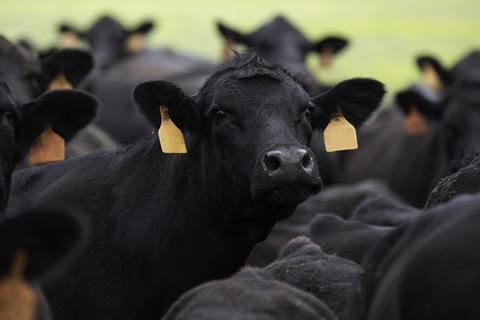
The epidemic was traced back to spinach obtained from a farm in San Benito County, California. Official reports found 26 samples of E. coli O157:H7 in the water and cattle manure of the farm. Investigators arrived at the consensus that runoff from nearby cattle ranches likely contaminated the irrigation water used for spinach crops. Since spinach is typically eaten raw, there is no cooking step to kill harmful bacteria before consumption. Once these contaminated leaves entered processing facilities, the bacteria spread rapidly to many bags during the washing and packaging stages. The investigation ended without any charges against the farm.
This severe outbreak resulted in nationwide recalls and major economic losses for growers, while also prompting much stricter food safety regulations and improved agricultural practices across the industry.
Is E. coli a friend or foe?
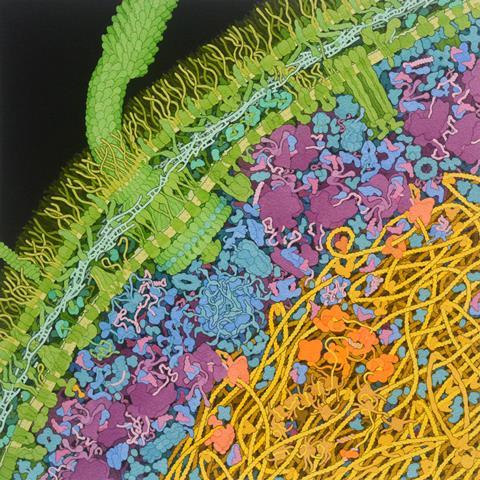
E. coli is perhaps one of the most well-known microorganisms. It is a bacterium mainly found in the gut of warm-blooded mammals and was discovered in 1885 by German-Austrian pediatrician and bacteriologist Theodor Escherich, who isolated the rod-shaped bacterium from infant feces. Originally termed Bacterium coli commune, as it was found in the colon, it was later named ‘Escherichia coli’ to honor its discoverer.
Despite the common notion, most strains of E. coli are often harmless. For example, E. coli Nissle 1917 is used as a helpful probiotic medicine. Some are even beneficial to the human digestive system, assisting with digestion, producing vital nutrients like vitamin K and B-complex, and competing with pathogenic invaders for space and nutrients, preventing harmful colonization.
E. coli’s notoriety stems from its specific pathogenic strains, notably STEC/EHEC (Shiga toxin-producing / Enterohemorrhagic E. coli), which lead to serious illnesses such as severe stomach cramps, bloody diarrhea, and potentially hemolytic uremic syndrome. In the United States alone, enterohemorrhagic E. coli (EHEC) results in approximately 100,000 illnesses and roughly 90 deaths each year. ETEC causes traveler’s diarrhea through toxin production, EPEC mainly affects infants by attaching to intestinal cells, and UPEC causes urinary tract infections and is responsible for the majority of community-acquired UTIs. Other illnesses caused by E. coli infections generally include gastroenteritis, bloodstream infections (sepsis), meningitis, pneumonia, and life-threatening kidney complications.
Discovery and development of colicins
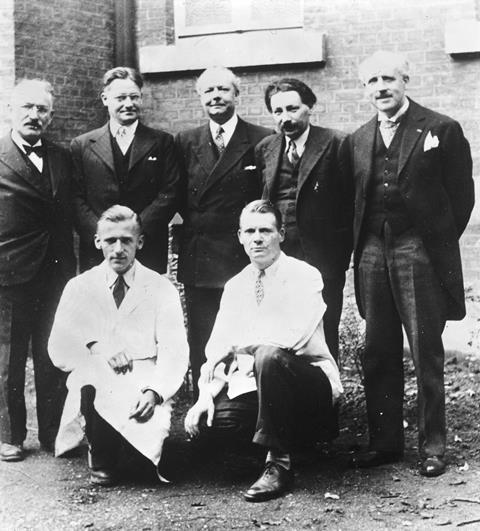
Surprisingly, the solution for E. coli infection came from E. coli itself. The discovery of colicins occurred during a period when microbiologists were attempting to understand why some bacterial strains could suppress the growth of others despite belonging to the same species. In 1925, French microbiologist André Gratia observed that cultures of one E. coli strain secreted a heat-labile substance capable of killing closely related E. coli strains without affecting the producer itself. At the time, the molecular nature of this substance was unknown, and it was initially regarded simply as an unusual antibacterial factor. Over the following two decades, Gratia continued investigating these antibacterial substances alongside Belgian microbiologist Pierre Fredericq. In1946, they formally introduced the term colicin, derived from the word coli, and demonstrated that these agents were in fact proteins with highly specific killing activity. Their work established the concept of bacterial antagonism, later giving way to a broader classification of bacteriocins as protein toxins produced by bacteria to inhibit or eliminate competitors.
The ecological significance of colicins became apparent several decades later. Since countless bacterial species coexist while competing for limited nutrients and space, the production of colicins provides certain E. coli strains with a powerful evolutionary advantage. By eliminating genetically similar competitors, while simultaneously expressing an immunity protein that neutralizes their own toxin, colicin-producing bacteria can secure their spaces. This phenomenon has often been described by microbiologists as a form of microbial warfare.
Research during the 1970s and 1980s further transformed the scientific relevance of colicins. It was discovered that many colicin genes are carried on transferable plasmids, known as Col plasmids, allowing the genetic ability to produce these toxins to spread between bacterial populations through horizontal gene transfer. Colicins subsequently became important models for studying receptor recognition, protein translocation across bacterial membranes, plasmid biology, and the molecular mechanisms underlying bacterial competition.
Interest in colicins declined somewhat following the widespread success of antibiotics such as penicillin and streptomycin during the mid-twentieth century. Because antibiotics possessed broad-spectrum activity and were relatively easy to manufacture, naturally occurring bacteriocins received comparatively little attention. However, the global rise of antimicrobial resistance during the late twentieth and early twenty-first centuries prompted scientists to revisit these protein toxins.
Structure and mechanism of colicins
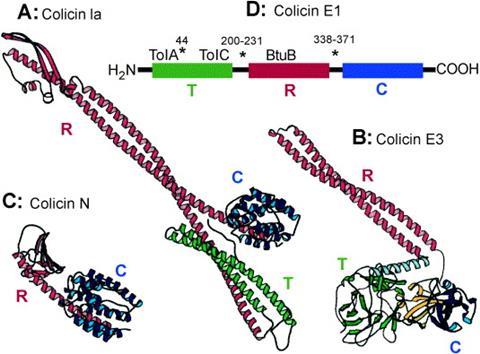
Colicins have a modular structure composed of three functional domains: a receptor-binding domain, which recognizes and attaches to target cells; a translocation domain, which enables the toxin to cross the target cell envelope; and a cytotoxic domain, which carries out the lethal activity against susceptible bacteria.
Colicin production and immunity are encoded by extrachromosomal elements called colicinogenic plasmids (Col factors). Colicin expression is controlled by three closely linked genes, often referred to as the colicin operon, which encode the colicin toxin, a specific immunity protein that protects the producing bacterium from its own toxin, and a lysis protein that facilitates the release of the colicin into the surrounding environment.
Colicins work by recognizing specific receptors on the surface of susceptible bacteria. Once attached, they employ various methods to eliminate susceptible bacterial cells. Some break down essential genetic material, such as DNA or RNA, while others create pores in the bacterial membrane. Alternatively, they might also inhibit the synthesis of peptidoglycan, the building block of the bacterial cell wall.
Future prospects and applications
The remarkable specificity of colicins makes them harmless for humans, and an attractive alternative to conventional antibiotics. Unlike broad-spectrum antibiotics, which often destroy both harmful and beneficial bacteria, colicins take selective action, effectively preserving the body’s natural microbiome. Several colicins also possess the ability to enhance the effectiveness of existing antibiotics by disabling bacterial efflux pumps, which are mechanisms that expel antibiotics from bacterial cells.
Their highly specific mode of action shows promise in terms of treating multi-drug resistant E. coli infections, while minimizing damage to beneficial bacteria. This could prove especially valuable in precision microbiome therapy. Investigations regarding the use of colicins alongside probiotics are also ongoing. This allows beneficial bacteria to establish themselves while simultaneously suppressing pathogenic strains. In clinical settings, colicins may also help prevent post-operative or hospital-acquired infections, particularly those caused by antibiotic-resistant bacteria.
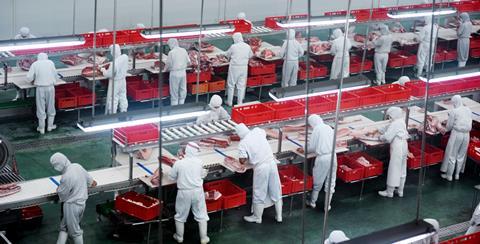
The most promising application of colicin relates to food safety, which is the target of most E. coli strains. Pathogenic strains such as enterohemorrhagic E. coli (EHEC), enterotoxigenic E. coli (ETEC), and Shiga toxin-producing E. coli (STEC) are common causes of food-borne illness worldwide. Colicins act as natural antimicrobial agents against them, and may be applied as sprays, dips, or antimicrobial coatings for fresh produce, meat-processing equipment, and food packaging, helping reduce contamination before food reaches consumers. This aids in impeding outbreaks like that of 2006, preventing a multitude of casualties.
Moreover, molecular farming allows green plants (such as tobacco, spinach, and lettuce) to accumulate substantial amounts of functional, recombinant colicins. These genetically engineered plants can serve as scalable bio-factories to produce active colicins. Additionally, specific combinations, like a blend of colicin M and colicin E7, effectively neutralize major enterohemorrhagic E. coli strains at very low concentrations. Excitingly, plant-derived colicin preparations have achieved favorable safety reviews, securing Generally Recognized as Safe (GRAS) status in the United States, underscoring that these crucial innovations are not too far in the future.
Limitations
Despite these developments, several challenges remain before colicins can achieve widespread clinical use. A major obstacle is improving their stability within the digestive tract. As protein molecules, colicins are susceptible to degradation by stomach acid and digestive enzymes, diminishing their activity before they reach their intended site of action.
Depending on the infection being treated, the proteins may need to resist enzymatic degradation within the bowels, penetrate bacterial biofilms, and/or remain stable in the bloodstream long enough to exert their antibacterial effects. Hence, equally important is the development of delivery systems that ensure colicins arrive at their targets.
Another challenge lies in developing cost-effective methods for large-scale production. Although recombinant DNA technology enables colicins to be produced in bacteria and plants, manufacturing sufficient quantities while maintaining consistent purity, biological activity, and quality remains technically demanding. Production processes must also be economically viable if colicins are to compete with existing antimicrobial treatments.
Conclusion
Nearly a hundred years later, colicins continue to be relevant and are being refined through advances in microbiology, protein engineering, and biotechnology. What emerged as a curious observation of bacterial competition has grown into a major industry, with applications ranging from medicine to agriculture. Thus, colicins prove that no matter how old a discovery is, it can still evolve and benefit mankind in novel ways.
Further Reading
Colicin - an overview | ScienceDirect Topics
Deciphering the Role of Colicins during Colonization of the Mammalian Gut by Commensal E. coli





No comments yet