
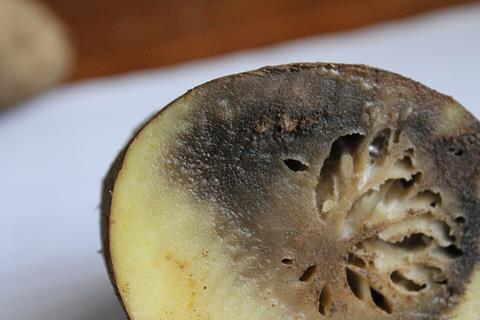
Late blight, caused by Phytophthora infestans, is a persistent threat to potato production worldwide. Breeders have long relied on resistance genes from cultivated and wild potato relatives, but these genes can be overcome as pathogen populations evolve.
At the same time, plant immune receptors must be tightly controlled: too little activity leaves plants exposed, while uncontrolled activation can damage growth. This makes susceptibility factors especially attractive, because disabling the host components that pathogens exploit may help reduce disease pressure while preserving normal development.
Based on these challenges, there is a need to investigate how susceptibility factors regulate NLR homeostasis and whether these hidden immune brakes can be used to build more durable potato resistance.
Plant genes lead to increased infection susceptibility
Researchers from China Agricultural University, Nanjing Agricultural University, the Chinese Academy of Agricultural Sciences, and collaborating institutions, published a new study in Horticulture Research. The article reveals how StRWA2 promotes late blight susceptibility by recruiting SNC1-INFLUENCING PLANT E3 LIGASE REVERSE 2 (StSNIPER2) to reduce the stability of NLR immune receptors in potato (Solanum tuberosum) and Nicotiana benthamiana.
The team first tested StRWA2 function in Nicotiana benthamiana, a model plant widely used for solanaceous immunity studies. Transient StRWA2 expression enlarged lesions after Phytophthora infestans infection, whereas virus-induced gene silencing (VIGS) of NbRWA2 increased resistance and activated defense-related genes.
In potato, Potato virus X (PVX)-based VIGS of StRWA2 intensified the hypersensitive response (HR) triggered by the Avr3a/R3a immune pair and reduced disease lesions. The strongest evidence came from RNA interference (RNAi) potato lines with reduced StRWA2 expression: these plants developed smaller lesions after inoculation with two Phytophthora infestans isolates and accumulated more reactive oxygen species (ROS), while showing no obvious change in plant height or morphology.
The researchers also tested whether StRWA2 worked through cell-wall acetylation, a known function of RWA proteins, but acetic acid release assays showed no significant change. Instead, co-immunoprecipitation (Co-IP), pull-down, protein stability, proteasome inhibitor, and ubiquitination assays showed that StRWA2 associates with R3a and Rpi-blb2, recruits StSNIPER2, enhances its ligase activity, and drives degradation of these NLR proteins through the 26S proteasome pathway.
Taking the breaks off of plant immunity
The authors said the findings shift attention from adding new resistance genes to removing a molecular aid used by the pathogen. They said StRWA2 acts like an immune brake: when it is active, NLR proteins are more readily degraded, weakening recognition-based defense; when StRWA2 is silenced, immune receptor stability improves and resistance rises. They also said the absence of visible growth defects in StRWA2-silenced plants is important because disease resistance must be compatible with crop performance before it can become useful in breeding or production.
MICROBIOLOGY NEWS: Register with The Microbiologist for more free articles
The study positions StRWA2 as a promising candidate for late blight resistance improvement through RNAi-based strategies, precision breeding, or genome editing after further validation. Because the StRWA2–StSNIPER2 module regulates the stability of existing immune receptors, adjusting this pathway could help potatoes maintain stronger defense without relying only on single resistance genes that pathogens may escape.
The work also broadens the idea of crop protection: instead of targeting pathogens directly, breeders may target host susceptibility pathways that pathogens exploit. Future studies should test different cultivars, field environments, pathogen populations, and partial-suppression strategies to confirm durability, agronomic performance, and regulatory feasibility.
Topics
- Agriculture
- Asia & Oceania
- crop pathogens
- crop protection
- Environmental Microbiology
- Food Safety & Security
- Food Security
- Food Security & Safety
- Fungi
- Healthy Land
- Mycology
- Nicotiana benthamiana
- Phytophthora infestans
- plant immune response
- potato late blight
- potatoes
- Research News
- resistance genes
- RNA interference
- Soil & Plant Science
- Solanum tuberosum






No comments yet