
Pseudomonas aeruginosa is an opportunistic pathogen associated with severe nosocomial infections. Its virulence and adaptation to environmental conditions are coordinated by complex signaling networks. While small RNAs (sRNAs) are established as post-transcriptional regulators of bacterial gene expression, the complete repertoire and functional roles of these non-coding molecules in P. aeruginosa have remained partially defined.
In a recent study published in Genes & Diseases, researchers from City University of Hong Kong, The Hong Kong University of Science and Technology, Guangdong Academy of Agricultural Sciences, Sun Yat-Sen University and Virginia Commonwealth University utilized a computational-experimental approach to map the sRNA landscape of this pathogen.
To detect conditionally expressed transcripts, the investigators developed a combined computational-experimental prediction pipeline to analyze intergenic RNA signals. This analysis established a pan-sRNome database encompassing 1,663 annotated sRNA sequences across 484 P. aeruginosa strains, identifying 58 representative sRNA homologs. Of these, nine novel intergenic sRNAs were validated via Northern blotting. Evolutionary analysis classified three of these newly identified transcripts (PA0806.1, PA3471.1, and PA4642.1) as core sRNAs present in all evaluated strains, while the remaining six (PA0982.1, PA1014.1, PA1270.1, PA1367.1, PA2734.1, and PA2736.2) were categorized as accessory elements.
Modulatory effects
Functional characterization of these novel regulators revealed distinct modulatory effects on pathogen virulence. The accessory transcript PA0982.1 was identified as a positive regulator of the rhl quorum sensing system. Biophysical assays demonstrated that PA0982.1 directly binds to the 5’ untranslated region of the rhlI mRNA, facilitating translation initiation. Genetic deletion of PA0982.1 reduced synthesis of the C4-HSL autoinducer, downregulated the downstream regulator rhlR, and decreased pyocyanin production.
Additionally, overexpression of PA1014.1, PA2734.1, and PA2736.2 increased pyocyanin levels through the upregulation of phenazine biosynthesis genes. Strains overexpressing PA1014.1 and PA2734.1 exhibited increased biofilm formation accompanied by elevated expression of the matrix-associated genes cupE and pslC. Conversely, PA2734.1 and PA2736.2 restricted swarming motility by downregulating the fimbrial biogenesis gene pilE.
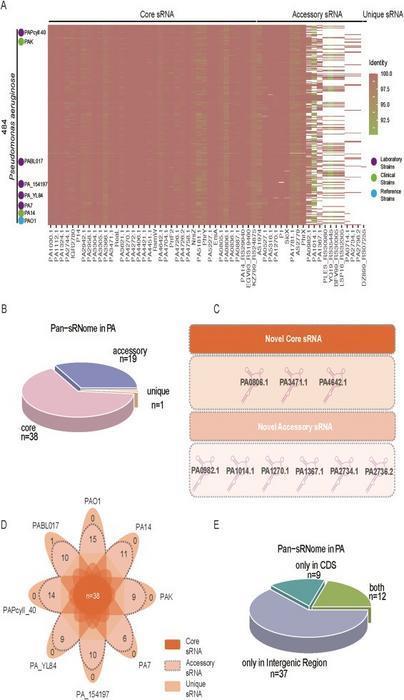
The study also demonstrated that overexpressing PA1270.1, PA1367.1, and PA3471.1 downregulates Type VI secretion system components, including hcpB and hsiB3, reducing competitive fitness against E. coli. Furthermore, evolutionary analysis across 23 distinct bacterial and archaeal species demonstrated selective conservation of these transcripts, illustrating their integration into bacterial genome structures.
MICROBIOLOGY NEWS: Register with The Microbiologist for more free articles
In conclusion, these findings demonstrate that core and accessory sRNAs coordinate post-transcriptional networks in P. aeruginosa. This pan-sRNome framework provides a metabolic and evolutionary model for investigating sRNA-mediated regulation, offering potential targets for future antimicrobial strategies.
Topics
- Asia & Oceania
- Bacteria
- City University of Hong Kong
- Guangdong Academy of Agricultural Sciences
- Infection Prevention & Control
- Infectious Disease
- Microbial Genetics
- One Health
- Pseudomonas aeruginosa
- regulators
- Research News
- small RNAs
- Sun Yat-sen University
- The Hong Kong University of Science and Technology
- Type VI Secretion System
- USA & Canada
- Virginia Commonwealth University
- virulence





No comments yet