
For years, researchers have been hoping for vaccines that protect people against not just one strain of HIV, but every strain of the quickly mutating virus. This requires a vaccine that coaxes the human body to develop something called broadly-protective antibodies—molecules that recognize a broad range of HIV strains.
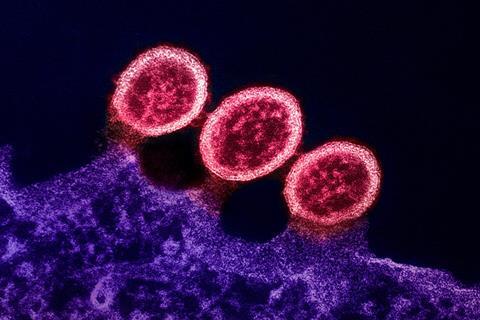
Now, scientists at Scripps Research and Sweden’s Karolinska Institute have developed an experimental vaccine that leads to broadly protective HIV antibodies in every rhesus macaque tested.
The finding, published in Nature on April 29, 2026, marks the first time vaccination alone has produced this reliable outcome and brings researchers closer to a vaccine effective against the vast diversity of HIV strains circulating worldwide.
The new vaccine targets a part of the HIV virus that rarely changes between strains—the tip, or apex, of HIV’s outer “spike” protein. The spike is the only part of HIV that is exposed on its surface and is responsible for its interactions with human cells. In six non-human primates, the vaccine against the spike apex led to antibodies that had activity against HIV strains the animals hadn’t previously been exposed to.
“This has been a long time coming,” says senior author Richard Wyatt, a professor at Scripps Research. “The fact that we see this response in all our animals tells us that we’re on to something. It’s better than we could have hoped for and incredibly gratifying.”
Rapid mutation
HIV mutates so rapidly that most immune responses in the human body cannot keep pace; by the time antibodies develop against one strain, the virus has mutated to evade them. A minority of people living with HIV do eventually develop broadly neutralizing antibodies (bnAbs): immune proteins that can block a wide range of strains because they recognize unchanging bits of HIV. But translating this response into a vaccine has proven difficult.
Wyatt’s lab has spent more than a decade developing an approach that lets them create virus-sized nanoparticles studded with hundreds of copies of HIV’s outer spike protein, called the Env trimer (in other words, a particle that looks like the HIV virus without causing disease). By varying which spike proteins are loaded onto the nanoparticles, the team can trigger different antibodies. Last year, using one version of this platform, Wyatt and his team showed that vaccinated macaques could develop bnAbs against the CD4 binding site, a critical spot where HIV’s spike interacts with human immune cells.
Spike apex
In the new work, they turned their attention to one of the virus’ other vulnerable regions: the apex of the spike. This site sits at the very top of the Env trimer and stays nearly identical across most of the hundreds of thousands of HIV strains in circulation.
“The apex is a very desirable vaccine target for two reasons,” says Scripps Research senior staff scientist Javier Guenaga, co-first author of the study. “It’s highly conserved across all HIV strains, and very potent bnAbs from people living with HIV have been previously isolated.”
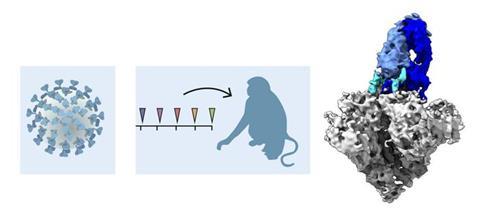
To create a vaccine that could reliably elicit these broad-acting antibodies against the apex, the researchers first had to find the right starting immunogen. Not all HIV spike proteins are equal when it comes to training the immune system; only some coax the immune system to create the rare immune cells that eventually give rise to apex-targeting bnAbs. So, the team first screened a library of stabilized HIV spike proteins to find ones that could recognize and activate those particular cells. Then, they used those spike proteins in their nanoparticle design.
Vaccination outcomes
When the group vaccinated six non-human primates with a series of these vaccines—beginning with a spike protein identified as the best priming candidate and then boosting with spike proteins from other HIV strains—all six animals developed apex-targeted cross neutralizing antibodies. Electron microscopy confirmed that the antibodies produced in the vaccinated animals bound to the spike’s apex in the same way as bnAbs isolated from humans living with HIV and had activity against multiple genetically distinct HIV strains they had never been exposed to. That activity, against wild HIV strains and not just ones in the vaccine, is known as tier-2 cross-neutralization.
“Tier-2 cross-neutralization is the benchmark in the field, and we achieved it in every animal,” says Scripps Research senior staff scientist Shridhar Bale, co-first author of the study. “When we got those results, it was really a ‘wow’ moment. We want the broader field to appreciate what has been achieved here.”
Next steps
The experimental vaccines aren’t yet ready for testing in humans; manufacturing clinical-grade versions of the nanoparticles is technically demanding and costly. The team is exploring other ways to deliver spike proteins that could elicit the same responses, including mRNA vaccines. Ultimately, a fully protective HIV vaccine will likely need to target the apex at the same time as other vulnerable sites on the spike such as the CD4 binding site.
“The field has made more progress in the last few years than in the previous 30 combined,” says Wyatt. “So now is the time to push forward with funding and research. We’re eager to get this translated to humans.”
In addition to Wyatt, Guenaga and Bale, authors of the study, “Vaccination generates broadly cross-neutralizing antibodies to the HIV Env apex,” include Swastik Phulera, Sashank Agrawal, Miyo Ota, Richard Wilson, Jocelyn Cluff, Tamar Dzvelaia, Wen-Hsin Lee, Agnes A. Walsh, Mariane Melo, Darrell Irvine, Ian Wilson, Andrew Ward and Gabriel Ozorowski of Scripps Research; Monika Ádori, Ioannis Zygouras, Fabian-Alexander Schleich, Xaquin Castro Dopico, Marco Mandolesi, Martin Corcoran and Gunilla B. Karlsson Hedestam of the Karolinska Institute; Laurent Verkoczy of the Applied Biomedical Science Institute; and Diane Carnathan and Guido Silvestri of Emory University.
This work was supported by funding from the National Institutes of Health HIV Vaccine Research and Design (HIVRAD) Program (P01 AI104722, P01 AI157299 and P01 AI124337), the Scripps Consortium for HIV/AIDS Vaccine Development (UM1 AI144462), the James B. Pendleton Trust, a Distinguished Professor grant from the Swedish Research Council (2017-00968), and the Emory National Primate Research Center (ORIP/ODP51OD011132 and U42PDP11023).

No comments yet