
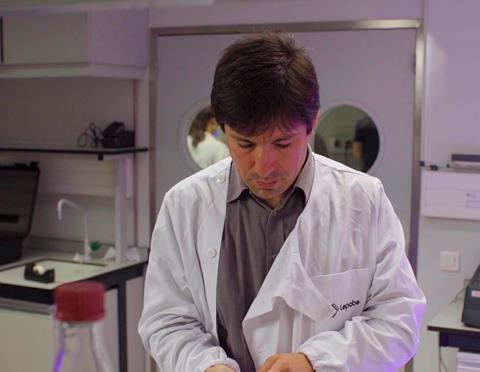
Professor Manuel Simões, Deputy Editor of the Journal of Applied Microbiology, has just been appointed as the journal’s new Lead Editor in Microbial Biotechnology. Here’s why he’s looking forward to the challenge.
The Journal of Applied Microbiology is kicking off 2026 with the unveiling of four key Research Themes under the JAM umbrella - Microbial Biotechnology; Systems Microbiology; Microbiology in Health & Disease; and Plant & Environmental Microbiology.
Each Theme encompasses emerging hot topics and leading-edge research that align with AMI’s goal to apply microbiology to solving the world’s greatest challenges.
Manuel, the new Lead Editor in Microbial Biotechnology, is an Associate Professor with Habilitation in the Department of Chemical Engineering at the University of Porto (FEUP). In a chat with The Microbiologist, he opened up on what lies ahead.
What excites you about heading up this new Research Theme?
What excites me most about leading this new Research Theme is the opportunity to define and elevate a strategic area at the forefront of applied microbiology. Microbial biotechnology sits at the intersection of fundamental discovery and tangible impact, with profound implications for healthcare, sustainable production, environmental remediation, and bio-based innovation.
By curating this theme, we can consolidate high-quality, solution-driven research that advances mechanistic understanding and accelerates translation into practice. It provides a structured platform within JAM to showcase emerging technologies, interdisciplinary methodologies, and transformative applications that are reshaping the applied microbiology field.
The aim is to position microbial biotechnology as a driver of applied microbiology-based innovation capable of addressing some of the most pressing global challenges.
What first sparked your interest in microbiology and how did your career develop?
My interest in microbiology began in high school, when I first observed rhizobacteria under the microscope. I was struck by the realisation that these microorganisms play fundamental roles in sustaining life and shaping ecosystems. At university, this curiosity evolved into a deeper appreciation of the power of microorganisms to solve real-world problems, particularly in wastewater treatment and environmental sustainability.
However, what truly captivated me was the remarkable ability of bacteria to organise into biofilms, highly structured, resilient communities that are extraordinarily difficult to control - their adaptive capacity and resistance to antimicrobial strategies presented both a scientific challenge and an opportunity for innovation.
Over time, my career naturally progressed toward applied microbiology, focusing on antimicrobial resistance and biofilm science and technology, particularly the development of biofilm control strategies.
What’s the microbe that most fascinates you and why?
The microbe that fascinates me most is Pseudomonas fluorescens, mainly because it is the microorganism I have worked with most extensively throughout my career. Over years of studying biofilms and synthetic microbial communities, I repeatedly observed P. fluorescens extraordinary capacity to form structured, resilient biofilms and to rapidly adapt to changing environmental conditions.
In mixed communities, P. fluorescens consistently demonstrated a remarkable ability to dominate, reshaping community composition through its strong surface colonisation, metabolic versatility, and competitive fitness. Working with this microorganism has allowed me to appreciate both its ecological sophistication and its applied relevance, particularly in understanding how biofilms form, persist, and can ultimately be controlled.
What real-world problem would you eventually love to solve with microbiology?
One real-world problem I would most like to solve is the lack of effective, sustainable strategies for biofilm control. Despite extensive research, we still rely primarily on conventional antibiotics or harsh chemical biocides, which are often ineffective against biofilms and contribute to resistance and environmental harm.
READ MORE: Manuel Simões appointed as Deputy Editor for the Journal of Applied Microbiology
READ MORE: Journal of Applied Microbiology launches new Research Themes for 2026
I am particularly motivated to develop sustainable biocides - targeted, environmentally responsible compounds that can disrupt biofilm structure and function without promoting antimicrobial resistance. The goal is to design strategies that interfere with biofilm formation, destabilise established communities, and enhance treatment efficacy while minimising ecological impact. Developing such solutions would have profound implications for healthcare, water systems, food processing, and industrial biofouling control.
What are the most intriguing new areas of research emerging in Microbial Biotechnology at the moment?
Some of the most compelling emerging areas in Microbial Biotechnology reflect a broader shift toward predictive, design-driven, and sustainability-focused microbiology. Precision microbiome engineering is moving beyond descriptive analyses to the rational modulation of microbial communities in health, agriculture, and environmental systems.
Synthetic biology and genome-scale engineering are enabling programmable microbes for carbon-neutral biomanufacturing, circular bioeconomy strategies, and climate resilience. The integration of artificial intelligence with systems biology is transforming our ability to model and control complex microbial networks.
At the same time, innovations in microbial control strategies are redefining how we address antimicrobial resistance. Collectively, these advances position microbial biotechnology as a central driver of sustainable technological solutions.
How important do you think the role of applied microbiology could be in solving some of the world’s problems?
Applied microbiology is fundamental to addressing many of today’s global challenges because microorganisms underpin health, environmental sustainability, food security, and industrial production. From combating antimicrobial resistance and controlling biofilms in clinical settings to enabling wastewater treatment, bioremediation, and sustainable biomanufacturing, applied microbiology translates fundamental knowledge into practical solutions.
Microbes can drive circular bioeconomy models, support carbon capture and valorisation, and reduce reliance on fossil-based processes. At the same time, understanding and managing microbial communities is essential for safeguarding public health and ecosystem stability. In many ways, applied microbiology provides not only tools to mitigate global problems but also innovative pathways toward more sustainable and resilient systems.
How would you persuade authors of the benefits of publishing in JAM?
JAM is a long-established, society-based journal with a strong scientific legacy. With decades of continuous publication, it has built a reputation for reliability, quality, and relevance within the applied microbiology community.
As a journal supported by a scientific society, it operates with editorial independence and a clear commitment to serving researchers rather than commercial interests. Authors benefit from rigorous, constructive peer review by active experts in the field, ensuring both scientific robustness and fairness.
Publishing in a society journal also means contributing to a broader mission: supporting conferences, early-career development, and community initiatives. Combined with its international readership and focus on impactful research, JAM offers both legacy and forward-looking visibility for authors’ work.
Looking in your crystal ball, what new areas of research can you see emerging in the next few years?
I anticipate rapid expansion in predictive and design-based microbiology, where artificial intelligence and machine learning are tightly integrated with experimental platforms to model, simulate, and ultimately control complex microbial systems. Rather than simply describing microbial communities, we will increasingly be able to forecast their behaviour under defined environmental pressures and rationally redesign them for specific functions.
Precision microbiome engineering is likely to evolve from correlation-based studies to targeted interventions, enabling controlled modulation of microbial consortia in human health, livestock production, crop resilience, and environmental restoration.
At the same time, sustainable bio-based production will continue to accelerate, with engineered microorganisms playing central roles in carbon capture and conversion, plastic degradation, nutrient recovery, and waste valorisation. Advances in synthetic biology and genome editing will enable microbes to function as programmable cell factories within circular bioeconomy frameworks. Collectively, these developments signal a transition toward microbiology that is not only analytical but truly constructive.
Is there anything else you would like to add?
As Deputy Editor of JAM and Lead Editor of the Microbial Biotechnology theme, I see the journal not simply as a venue for publication, but also as a reference platform actively shaping the direction of applied microbiology. I am especially committed to fostering interdisciplinary contributions and supporting emerging researchers who are driving innovation in microbial biotechnology.
Ultimately, this role is an opportunity to help position applied microbiology as a fundamental driver of scientific solutions to global challenges, ensuring that rigorous research translates into meaningful real-world advances.
Find out more about submitting your research to the Journal of Applied Microbiology.






No comments yet