
Metabolic dysfunction-associated steatohepatitis (MASH) is often viewed through the lens of hepatic lipid accumulation, inflammation and fibrosis. A new study published in eGastroenterology shifts attention upstream, identifying intestinal neutral ceramidase as a gut-derived driver of MASH progression through its effects on microbial metabolism, epithelial signalling and intestinal barrier function.

Using mice with intestinal epithelial cell-specific deletion of Asah2, the gene encoding neutral ceramidase, Wang and colleagues showed that loss of this enzyme protected animals from diet-induced MASH. Notably, this protection was not mainly explained by reduced steatosis. Instead, Asah2-deficient mice displayed less liver fibrosis, lower inflammatory injury, improved gut barrier integrity and reduced lipopolysaccharide translocation. These findings support the concept that MASH progression can be driven by intestinal inflammatory signals even when hepatic fat accumulation is not substantially altered.
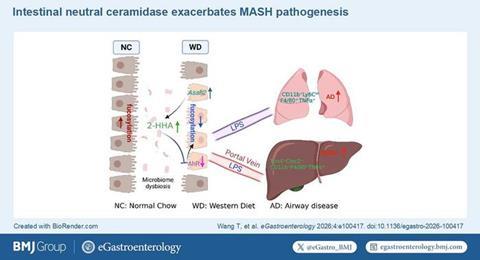
The mechanistic breakthrough lies in the identification of a microbiota–metabolite–epithelium pathway. Intestinal neutral ceramidase altered gut microbial composition and metabolite profiles, increasing the production of 2-hydroxyhippuric acid (2-HHA). The study identified 2-HHA as an inhibitor of epithelial aryl hydrocarbon receptor (AhR) signalling. Because AhR normally promotes intestinal epithelial fucosylation, increased 2-HHA suppressed AhR activity, reduced fucosylation and weakened mucosal barrier function. Conversely, intestinal epithelial Asah2 deletion reduced 2-HHA, restored AhR signalling and enhanced fucosylation.
Protection against MASH
The authors further demonstrated causality using germ-free mice and faecal microbiota transplantation. Microbiota from Asah2-deficient mice conferred protection against MASH, indicating that intestinal neutral ceramidase shapes a disease-relevant microbial ecosystem. In parallel, intestinal AhR deficiency worsened MASH and reduced fucosylation, whereas fucoidan supplementation increased fucosylation, improved barrier function and attenuated disease severity.
An accompanying editorial by Cristina Llorente highlights the broader significance of these findings. The commentary emphasizes that epithelial fucosylation is not merely a surface modification, but a functional regulator of microbial ecology and epithelial homeostasis. It also notes that 2-HHA is best interpreted as a host–microbe co-metabolite rather than a purely microbial product. Importantly, the editorial cautions that fucosylation may be context-dependent: it can support barrier protection in one setting, yet have different effects depending on diet, microbial composition, substrate availability and host signalling status.
Beyond the liver
The study also extends beyond the liver. Both intestinal neutral ceramidase and epithelial AhR influenced lung inflammation, supporting a gut–liver–lung axis in metabolic disease. This suggests that intestinal barrier dysfunction and microbial metabolites may contribute to systemic immune activation, not only hepatic injury.
MICROBIOLOGY NEWS: Register with The Microbiologist for more free articles
From a translational perspective, the work identifies several potential intervention points: selective modulation of intestinal neutral ceramidase, targeting 2-HHA-related metabolic pathways, restoring AhR activity, and using microbiome- or prebiotic-based approaches to reinforce epithelial fucosylation and barrier integrity. However, clinical application will require validation in human cohorts, careful assessment of safety and specificity, and clarification of when fucosylation-enhancing strategies are protective versus potentially harmful.
Overall, this study reframes MASH as a disease of integrated gut–microbe–epithelial–liver communication. By identifying intestinal neutral ceramidase as an upstream regulator of microbial metabolism and barrier function, it opens a new avenue for therapies designed not only to reduce liver fat, but also to prevent inflammatory and fibrotic progression through restoration of intestinal homeostasis.
See the articles:
- Wang T, Chen L,Lei C, et al. Intestinal neutral ceramidase exacerbates MASH pathogenesis. eGastroenterology 2026;4:e100417. doi:10.1136/egastro-2026-100417
- Llorente C. Intestinal neutral ceramidase, microbial metabolites and epithelial fucosylation in MASH. eGastroenterology 2026;4:e100458. doi:10.1136/egastro-2026-100458






No comments yet