
Scientists have proposed a new framework for understanding how microbes, soil fauna, viruses and compounds in the soil can be used alongside agricultural practices to reshape the native plant microbiome and boost plant performance.
The pan-European team published their proposal as part of a review of the latest advances in microbiome modulation—the deliberate steering and optimization of plant-associated microbial communities—to show how this emerging concept can help develop more sustainable, climate-resilient agri-food systems while reducing reliance on synthetic fertilizers and pesticides.
The paper, ‘Microbiome modulation for sustainable crop production and climate resilience’ was published in Sustainable Microbiology, an Applied Microbiology International publication.
Plant microbiome
The plant microbiome comprises diverse communities of microorganisms that live in association with plants and interact with their roots, leaves, stems, flowers, fruits, seeds and surrounding soil. Such microbial communities play key roles in plant growth, nutrient acquisition, tolerance to abiotic stresses and disease suppression, said lead author Dr. Malek Marian of the AIT Austrian Institute of Technology in Austria.
MICROBIOLOGY NEWS: Register with The Microbiologist for more free articles
“Building on this concept, our international team reviewed the latest advances in microbiome modulation—the deliberate steering and optimization of plant-associated microbial communities—to show how this emerging concept can help develop more sustainable, climate-resilient agri-food systems while reducing reliance on synthetic fertilizers and pesticides,” he said.
“By bringing together evidence from hundreds of recent studies, we propose a new framework for understanding how biological modulators (microorganisms, soil fauna, viruses and compounds) applied individually or in combination, together with agricultural management practices can reshape the native microbiome within the broader phytobiome, leading to improved functions and plant performance.”
Food security and sustainability
Agriculture faces the challenges of simultaneously producing more and better-quality food while reducing environmental impacts and adapting to climate change. Conventional farming relies heavily on synthetic fertilizers and pesticides, but these approaches are becoming unsustainable.
“Plants naturally live with diverse and beneficial microbial, faunal and viral communities that influence plant growth, nutrient acquisition, disease suppression and tolerance to abiotic stresses. Our review explores the latest strategies and tools for deliberately modulating the plant microbiome to support sustainable and resilient agriculture,” Dr Marian said.
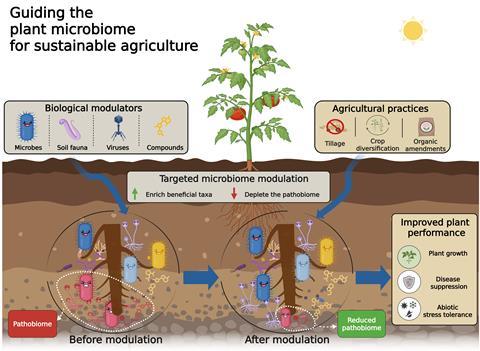
The team reviewed the latest research on plant microbiomes by bringing together knowledge from plant (micro)biology, microbial ecology, soil biology and systems biology, and evaluated how beneficial biological modulators like bacteria, fungi, protists, nematodes, and bacteriophages, as well as plant-derived metabolites, compounds and nutrients act to steer and optimize the native plant microbiome. They also explored how agricultural practices can support these approaches.
Promising new approaches
Finally, they identified promising new approaches for microbiome modulation, such as function oriented, multitrophic defined microbial communities assembled based on ecological traits and interactions across multiple trophic levels to enable their establishment and function within the phytobiome; temperate phages; microbiome transplantation and breeding; and functional synbiotics, defined as combinations of beneficial microorganisms and compounds that improve microbiome health and function.
“We were surprised by the number of successful examples of complex defined microbial community design that produced beneficial outcomes for plants. We were also struck by how actively plants react to environmental stresses by exploiting the associated microbiome, that is shaped through root exudates, specialized root metabolites, and immune responses,” Dr Marian said.
Shift in emphasis
The work highlights a shift from asking ‘Which beneficial microorganism should we apply?’ to ‘How can we guide the entire plant microbiome within the broader phytobiome to support healthy plants?’. The research field on the plant microbiome has advanced rapidly over the past decade.
MICROBIOLOGY ON TAP: Get full access to all The Microbiologist articles from just £2.17 a month
“Rather than focusing on individual beneficial members of the plant microbiome or single agricultural practices, we believe that combining complex microbiome members and their functions with sustainable and integrated agricultural practices can better support plant health, productivity and resilience,” Dr Marian said.
“Successfully managing the plant microbiome could reduce dependence on synthetic fertilizers and pesticides, improve resilience to climate change, enhance soil health and contribute to more sustainable food production.
Next steps
“The next challenge is translating scientific discoveries into robust field applications. This requires a better understanding of key ecological processes such as microbiome assembly and interactions under diverse environments (soil and climate).
“It also requires improved predictive tools integrating biological data, computation modelling, and artificial intelligence to guide management decisions. Future crop improvement will increasingly integrate microbiome knowledge with plant breeding and sustainable agricultural practices to develop more reliable and resilient technologies.”
The review was led by Dr. Malek Marian of the AIT Austrian Institute of Technology in Austria and brought together an international team with complementary expertise in plant microbiology, plant pathology, microbial ecology, data science, and sustainable agriculture.
The co-authors were Dr. Ioannis Stringlis of the Agricultural University of Athens, Greece; Dr. Eleonora Rolli of the University of Milan, Italy; Dr. Christopher James Barnes of Aarhus University and the University of Copenhagen, Denmark; and Dr. Stéphane Compant and Dr. Angela Sessitsch of the AIT Austrian Institute of Technology, Austria.
‘Microbiome modulation for sustainable crop production and climate resilience’ is published in Sustainable Microbiology.
Topics
- Aarhus University
- Agricultural University of Athens
- Agriculture
- agri-food systems
- Angela Sessitsch
- Applied Microbiology International
- Austrian Institute of Technology
- Bacteriophages
- Christopher James Barnes
- Community
- Eleonora Rolli
- Food Security
- functional synbiotics
- Healthy Land
- Ioannis Stringlis
- Malek Marian
- metabolites
- microbiome modulation
- plant microbiome
- Research News
- Soil & Plant Science
- Stéphane Compant
- Strategies for Sustainability
- UK & Rest of Europe
- University of Copenhagen
- University of Milan




No comments yet