
A comprehensive bibliometric analysis spanning 55 years of Lassa virus (LASV) research has uncovered significant disparities in scientific output between high-income and endemic countries, while revealing a persistent shortage of studies addressing environmental factors influencing viral spread.
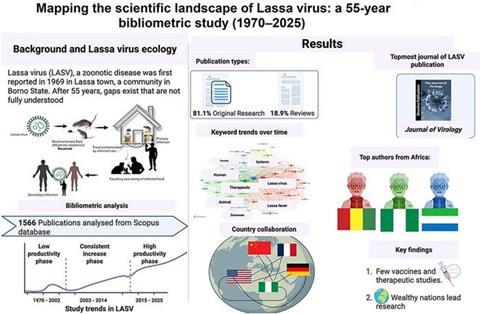
The study, published in Science in One Health, examined 1,566 peer-reviewed publications indexed in Scopus from 1970 to 2025, tracing the evolution of LASV research over five decades. The findings paint a complex picture of a field that, despite growing interest, remains fragmented and geographically skewed.
Three Distinct Phases of Research Growth
The research identified three distinct productivity phases: a low-output period from 1970 to 2002, a phase of consistent growth from 2003 to 2014, and a high-productivity period from 2015 to 2025. Throughout this timeline, the Journal of Virology emerged as the leading publication venue for LASV research. Original research articles dominated the literature, accounting for 81.10% of all publications, indicating a robust foundation of empirical investigations.
However, this quantitative growth masks a troubling reality: the distribution of research capacity is profoundly unequal. While the United States leads global collaborative efforts on LASV research, only 20% of the top 50 most prolific authors are based in countries where Lassa fever is endemic. This disparity raises critical questions about research ownership, local capacity building, and the relevance of investigations to the communities most affected by the disease.
Environmental Blindspot in Viral Research
A keyword and thematic analysis revealed an unexpected but significant gap: relatively few studies focus on environmental factors that influence LASV transmission and spread. This oversight is particularly concerning given that understanding ecological and environmental drivers is essential for predicting outbreaks and implementing effective prevention strategies—core principles of the One Health approach.
The One Health framework, which recognizes the interconnectedness of human, animal, and environmental health, has become increasingly vital for addressing zoonotic pathogens like LASV. Yet the bibliometric evidence suggests that much of the existing LASV literature has not fully embraced this integrated perspective.
Implications for Future Research
The findings underscore the need for a deliberate, strategic shift in how LASV research is conducted and prioritized globally. Specifically, the study advocates for:
- Enhanced regional research capacity: Greater investment in research infrastructure and training in endemic regions, enabling local scientists to lead investigations and contribute more substantially to the global knowledge base.
- Environmental health integration: Increased focus on ecological and environmental drivers of LASV transmission, bridging gaps between virology, epidemiology, and environmental science.
- Collaborative models that center affected communities: Research partnerships designed not only to solve immediate public health problems but also to build lasting scientific capacity in regions disproportionately burdened by Lassa fever.
As Lassa virus continues to pose a persistent public health threat in West Africa and beyond, this bibliometric study serves as both a diagnostic tool and a call to action. It demonstrates that increasing publication volume alone is insufficient; the field must intentionally reshape its research agenda to address critical gaps and ensure that knowledge production benefits the populations most vulnerable to this devastating disease.
The research provides a roadmap for the scientific community: to move beyond fragmented, externally-driven investigations toward a truly integrated One Health approach that places environmental understanding and local expertise at the center of LASV research and control efforts.







No comments yet