
In World AMR Awareness Week, Ran Frenkel, Co-Founder and CEO of Polaroid Therapeutics, argues that preventing infections, particularly in chronic wounds, must become a greater priority – and innovative non-antibiotic treatments can help protect patients and preserve the antibiotics we have left.
Every week in England, an average of 406 people develop a bloodstream infection that standard antibiotics may fail to treat, according to UKHSA’s latest ESPAUR report. Prescribers have done what was asked of them, cutting antimicrobial use by more than a tenth since 2019. Yet resistant infections now sit about a quarter above the level the National Action Plan set out to hold. As UKHSA itself warns, “we can’t rely on reducing antibiotic use alone.” Most of our effort has gone into rationing antibiotics, and much less into reducing the infections that need them.

That burden falls unevenly. Resistant bacteraemia is 44% higher in England’s most deprived areas than in the least deprived, and half of all cases are in people over 75. Long-term illness explains much of this. Nearly a quarter of people with type 2 diabetes in the UK live in the most deprived areas, compared with 15% in the least deprived, and cardiovascular disease follows the same pattern. Combine those conditions with age and limited mobility and you get wounds that stay open for months. Every day a wound stays open is another day bacteria can get in.
The diabetic foot shows how quickly this escalates. Nerve damage means a blister can go unnoticed. Poor circulation means it heals slowly once it is found. Between a fifth and a third of people with diabetes will develop a foot ulcer in their lifetime. Around half of those ulcers become infected, and one in five of these infections ends in amputation.
Diabetic foot ulcers are part of a much wider problem of chronic wounds, costing the NHS £8.3 billion a year and driving antibiotic prescribing. One UK primary care study found that patients with chronic wounds received significantly more antibiotic courses than those without. Chronic wounds are typically colonised by polymicrobial biofilm, which tolerates antibiotic concentrations far above the minimum inhibitory concentration (MIC), while systemic antibiotics reach a poorly perfused wound bed at low levels. Repeated courses clear the free floating bacteria, leave the biofilm behind, and select for whatever survives. Because chronic wounds cluster in older and poorer populations, resistance becomes one more health inequality.
Practice gaps
When we interviewed wound care nurses in the UK about how antibiotics and antibacterial dressings are used, we heard about real gaps between best practice and what happens day to day. The dressing a protocol recommends is not always the one the clinic has in stock. Patients don’t always follow the dressing regimen they are given. Nurses are left trying to protect antibiotics while caring for patients who genuinely need antibacterial treatment, and the tools they have often don’t fit the job.
ESPAUR already shows that preventing infection without antibiotics can work. Between 2019 and 2025, use of methenamine hippurate, a non-antibiotic urinary antiseptic for preventing recurrent UTIs, rose by 48%. In turn, dispensing of nitrofurantoin, an antibiotic often prescribed for the same purpose, fell most sharply in the areas where methenamine uptake was highest. Wound care needs the same shift, but today’s options come with trade-offs. Silver- and iodine based dressings kill bacteria, but they can also harm the keratinocytes and fibroblasts that healing depends on. Resistance is a concern too. In a series of in vitro studies with Professor Matthew Hardman at the University of Hull’s Wound Innovation Institute, we found that several commonly used antibacterial dressings drove the development of resistance in the bacteria exposed to them. That is not a reason to stop using them, and these dressings play an important role in delivering antimicrobial treatment to infected wounds. However, it does mean we need to be careful about choosing the right dressing for each wound, and to do more to stop infection from taking hold in the first place.
Contact-killing dressings
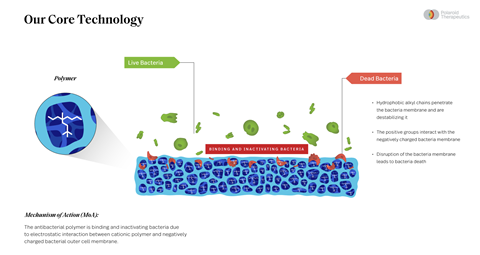
What wound care needs is an antimicrobial that doesn’t leach into the wound, doesn’t have to get inside the bacterium to work, and leaves host tissue alone. That is the design brief behind a newer class of contact-killing dressings, including the one Polaroid Therapeutics has developed. Its active ingredient is a cationic polymer bound to the fibre, which disrupts the bacterial cell envelope on contact instead of releasing an agent into the wound. Because nothing is released, bacteria around the wound are never exposed to a weak dose they can adapt to.

In testing at the same institute, our dressing reduced Staphylococcus aureus to below the limit of detection within 30 minutes and kept it suppressed for 24 hours. Silver dressings tested alongside ours still carried more than 100 times more bacteria, and one allowed regrowth. These are in vitro results, so our next questions are how it performs in biofilm models, against Gram-negative pathogens such as Pseudomonas aeruginosa, and in patients, starting with an upcoming post market clinical follow-up study. If the results hold in clinical practice, they could mean fewer infected wounds, fewer antibiotic courses and better healing.
MICROBIOLOGY NEWS: Register with The Microbiologist for more free articles
Wound care is just one example of where real progress can be made. The ECDC estimates that half of the AMR burden linked to healthcare-associated infections could be prevented with stronger infection prevention and control. Where infection is predictable, as it so often is in chronic wounds, preventing it protects both patients and the antibiotics we have left.
England’s 10 Year Health Plan promises a shift from sickness to prevention, and AMR is a good place to test whether that promise is real. As the NHS sets its priorities for 2027, infection prevention needs the same weight and funding as the prescribing targets in the National Action Plan. Commissioning should reward community services for infections avoided, not just antibiotics withheld. Non-antibiotic alternatives need a faster route to patients, starting with chronic wounds, and clinics need to actually have them in stock. Stewardship asks clinicians to prescribe less, but prevention gives them fewer reasons to prescribe at all. We need both if the weekly count of 406 resistant bloodstream infections is going to start falling.
Ran Frenkel is co-founder and CEO of Polaroid Therapeutics, which develops the dressing described in this article.
Topics
- antibacterial dressings
- Antimicrobial Resistance
- bacteraemia
- Bacteria
- Biofilms
- cationic polymers
- chronic wounds
- diabetic foot ulcers
- Infection Prevention & Control
- Infectious Disease
- Matthew Hardman
- methenamine hippurate
- One Health
- Polaroid Therapeutics
- polymicrobial biofilm
- Pseudomonas aeruginosa
- Ran Frenkel
- Staphylococcus aureus
- UK & Rest of Europe
- University of Hull
- World AMR Awareness Week






No comments yet