
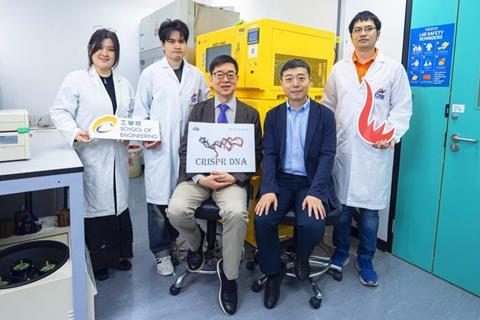
A research team led by Prof. Hsing I-Ming, Professor of the Department of Chemical and Biological Engineering (CBE) at The Hong Kong University of Science and Technology (HKUST), in collaboration with Prof. Zhai Yuanliang, Associate Professor of the Division of Life Science (LIFS), has successfully developed the world’s first DNA-guided CRISPR-Cas system capable of programmable RNA targeting and cleavage.
This breakthrough overturns the conventional CRISPR paradigm, which uses RNA as a guide to target DNA. The new system holds tremendous potential for clinical applications, opening new avenues for RNA-targeted therapies and diagnostics, including improved accuracy in rapid infectious disease testing and the advancement of antiviral treatments. The findings have been published in the international prestigious journal Nature Biotechnology.
Reprogramming the GPS navigation system
The operation of the CRISPR Cas system can be understood using the analogy of a Global Positioning System (GPS). Prof. Hsing I-Ming explained, “The RNA guide molecule is like the address you type in, and the Cas protein is the car that drives to that address – the DNA target. Traditional detection platforms including SHERLOCK and DETECTR are all based on this principle.”
The HKUST team has proposed a new approach. By combining a newly developed DNA-guided Cas12a system with isothermal amplification, they constructed a revolutionary diagnostic platform called SLEUTH (Specific Locus Evaluation Utilizing Targeted Hydrolysis), successfully inverting the traditional method.
Through engineering, the team designed a synthetic “CRISPR DNA” (crDNA) molecule that reprograms the Cas12a protein to use DNA as a guide, directing the Cas protein to target different RNA molecules. This paradigm-shifting innovation opens up an entirely new design space for programmable RNA tools.
Decoupling the instruction from the activation
The key to this breakthrough lies in a clever structural insight. The research team decoupled two functions that are normally combined in the natural CRISPR system: the “activation” signal (the PAM sequence) and the “information-carrying” address. By designing a short DNA strand that mimics the PAM-containing duplex, they created a functional deoxyribonucleoprotein complex capable of recognizing and cleaving any selected RNA target.
To validate the design, the team combined three advanced technologies: AlphaFold-guided modeling, molecular dynamics simulations, and high-resolution cryo-electron microscopy (cryo-EM). The experimental cryo-EM structure determined by Prof. Zhai Yuanliang and co-first author Dr. Lam Wai-Hei, postdoctoral fellow in the LIFS, closely matched the computational predictions, thereby confirming the feasibility of this artificial activation pathway.
“It is thrilling to collaborate with the innovative engineers on Prof. Hsing’s team,” said Prof. Zhai. “Observing the synthetic DNA guide interacting with Cas12a at atomic detail was incredibly exciting. This clearly demonstrates how AI-driven design and structural biology can work together synergistically.”
Advantages of DNA guidance
Compared to existing RNA-based CRISPR diagnostics (such as SHERLOCK) and RNA-interference (RNAi) tools, the new DNA-guided system offers several practical advantages:
• More stable, no cold chain required: Synthetic DNA has significantly greater chemical stability than RNA and does not require specialized cold-chain storage. RNA guide molecules degrade easily at room temperature and must be frozen, whereas DNA guide molecules are far more stable at ambient temperatures. RNA-guided methods generally require cold-chain storage and handling, while the DNA-guided method has no such limitation, greatly reducing synthesis costs and supply chain complexity.
• Lower cost: Synthetic DNA is significantly cheaper to manufacture than RNA. While the team has not conducted a formal cost analysis, the industry principle is that RNA synthesis requires additional chemical protection steps, and RNA guides typically need cold-chain handling, adding logistical expense.
• Greater precision: The system can discriminate single-nucleotide differences in the target RNA sequence – a level of accuracy that RNAi typically cannot achieve.
• Wider applicability: RNAi is largely limited to silencing protein-coding mRNA. This new system can target any RNA molecule, including non-coding RNAs (microRNAs, and long non-coding RNAs), which are key regulators of gene expression and disease.
• Safer for therapy: Compared to existing RNA-targeting CRISPR tools such as Cas13, the new Cas12a-based system significantly less off-target RNA cleavage in cells – meaning fewer collateral effects – a critical safety consideration for future therapeutic development.
The team has successfully validated the SLEUTH platform’s exceptional detection sensitivity using 31 clinical samples of SARS-CoV-2. Results showed attomolar-level sensitivity for both RNA and DNA targets across various conditions. The DNA-guided method is particularly well-suited for point-of-care deployment in clinics, airports, and resource-limited settings without cold-chain storage requirements.
Concrete disease relevance: From COVID-19 to future pandemics
“Hong Kong and the broader region have been repeatedly affected by viral pathogens – from SARS and influenza to COVID-19,” noted Prof. Hsing. Many of these viruses carry RNA genomes or rely on RNA intermediates to replicate. A DNA-guided CRISPR tool capable of precisely cleaving those RNA molecules could form the basis of a new class of antiviral intervention.
Mr. Wu Xiaolong, a PhD student in the Department of Chemical and Biological Engineering and co-first author of the study, said, “Compared with traditional crRNA-based systems, our DNA-guided design replaces RNA with a more stable DNA guide, demonstrating a mechanism never before seen in natural CRISPR systems. We look forward to extending this concept to more RNA-based diagnostics and therapeutics.”
Patents and Future Development
HKUST has filed two U.S. provisional patents for this innovative technology and is actively exploring its applications in RNA diagnostic testing, antiviral therapies, live-cell RNA imaging, and programmable RNA transcript regulation. Over the next three years, the team plans to expand the SLEUTH platform to detect other respiratory viruses and explore its potential in liquid biopsy applications to identify circulating RNA biomarkers in cancer. This work aligns closely with HKUST’s newly established School of Medicine and the University’s growing emphasis on translational medicine and RNA-based therapies.
Topics
- Asia & Oceania
- Bacteria
- Bioengineering
- Clinical & Diagnostics
- COVID-19
- Disease X
- DNA-guided CRISPR-Cas
- Hsing I-Ming
- Innovation News
- Lam Wai-Hei
- Microbial Genetics
- One Health
- Rapid Diagnostics
- SARS-CoV-2
- SLEUTH
- Synthetic Biology
- The Hong Kong University of Science and Technology
- Viruses
- Wu Xiaolong
- Young Innovators
- Zhai Yuanliang






No comments yet