
Invasive fungal infections caused by pathogens such as Candida albicans represent a significant threat to human health, with high mortality rates among patients with weakened immune systems. Although antifungal drugs remain the primary treatment option, increasing drug resistance and limited therapeutic effectiveness highlight the urgent need for preventive strategies. However, developing effective fungal vaccines has been challenging due to insufficient antigen immunogenicity and difficulties in inducing durable cellular immune responses.
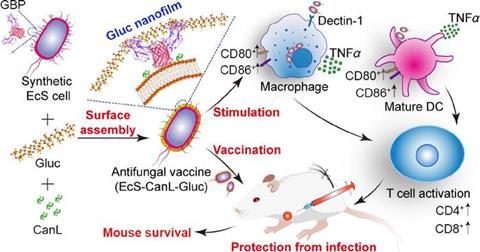
A research team led by Qilin Yu from the School of Life Sciences at Nankai University has developed a synthetic bacterium-based vaccine platform that uses engineered bacterial surfaces to assemble glucan nanofilms for enhanced antifungal immunity. The research is published in Nano Research.
The researchers genetically modified Escherichia coli cells to express an artificial glucan-binding protein, enabling the bacteria to recruit β-glucan molecules and form a uniform nanofilm coating on their surfaces. The glucan nanofilm was further integrated with candidalysin (CanL), a key virulence-associated antigen from Candida albicans, generating an engineered antifungal vaccine termed EcS-CanL-Gluc.
This surface-engineered bacterial vaccine provides a unique strategy to spatially organize immune stimulatory components and antigens on a single biological interface. The glucan nanofilm mimics fungal-associated molecular patterns and activates Dectin-1-mediated immune recognition, promoting macrophage and dendritic cell maturation. Meanwhile, the displayed CanL antigen enhances antigen-specific immune responses by stimulating CD4⁺ and CD8⁺ T cell activation.
“Our goal was to create a synthetic microbial platform that integrates antigen presentation and immune stimulation within a programmable bacterial surface,” said Qilin Yu, senior author of the study. “This approach provides a new avenue for designing vaccines against complex infectious diseases by harnessing the natural immune recognition mechanisms of microbial structures.”
Immune cell activation
Cellular studies demonstrated that EcS-CanL-Gluc efficiently promoted immune cell activation, increasing the expression of antigen presentation markers and inflammatory cytokines associated with protective antifungal responses. Transcriptomic analysis further revealed that vaccination reshaped macrophage immune programs and activated key inflammatory and antimicrobial pathways, including NF-κB, TNF, and IL-17 signaling.
In mouse models of systemic Candida albicans infection, vaccination with EcS-CanL-Gluc significantly improved survival outcomes, reduced fungal burden in infected organs, and alleviated tissue damage compared with non-vaccinated controls. The vaccine induced strong Th1-associated immune responses and enhanced pathogen clearance, demonstrating its potential for preventing invasive fungal infections.
MICROBIOLOGY NEWS: Register with The Microbiologist for more free articles
The study establishes a new paradigm for bacterial surface engineering by transforming synthetic microorganisms into multifunctional vaccine carriers. By combining programmable nanomaterial assembly with immune modulation, this platform may provide opportunities for developing next-generation vaccines against fungal pathogens and other infectious diseases.
“The next step will be to further optimize this synthetic bacterial platform and explore its broader applications in infectious disease prevention and immunotherapy,” said Yu.



No comments yet